IYABOKO Science & Technology Technology Infrastructure · Software + Hardware + AI + Assurance
Technology Infrastructure · AI + Software + Hardware + Assurance

Turn complex real-world problems into evidence-governed technology pathways.

IYABOKO combines computational intelligence, AI-assisted research, evidence governance, simulation, engineering and assurance to help organisations move from early exploration toward validated pilots and responsible real-world deployment.

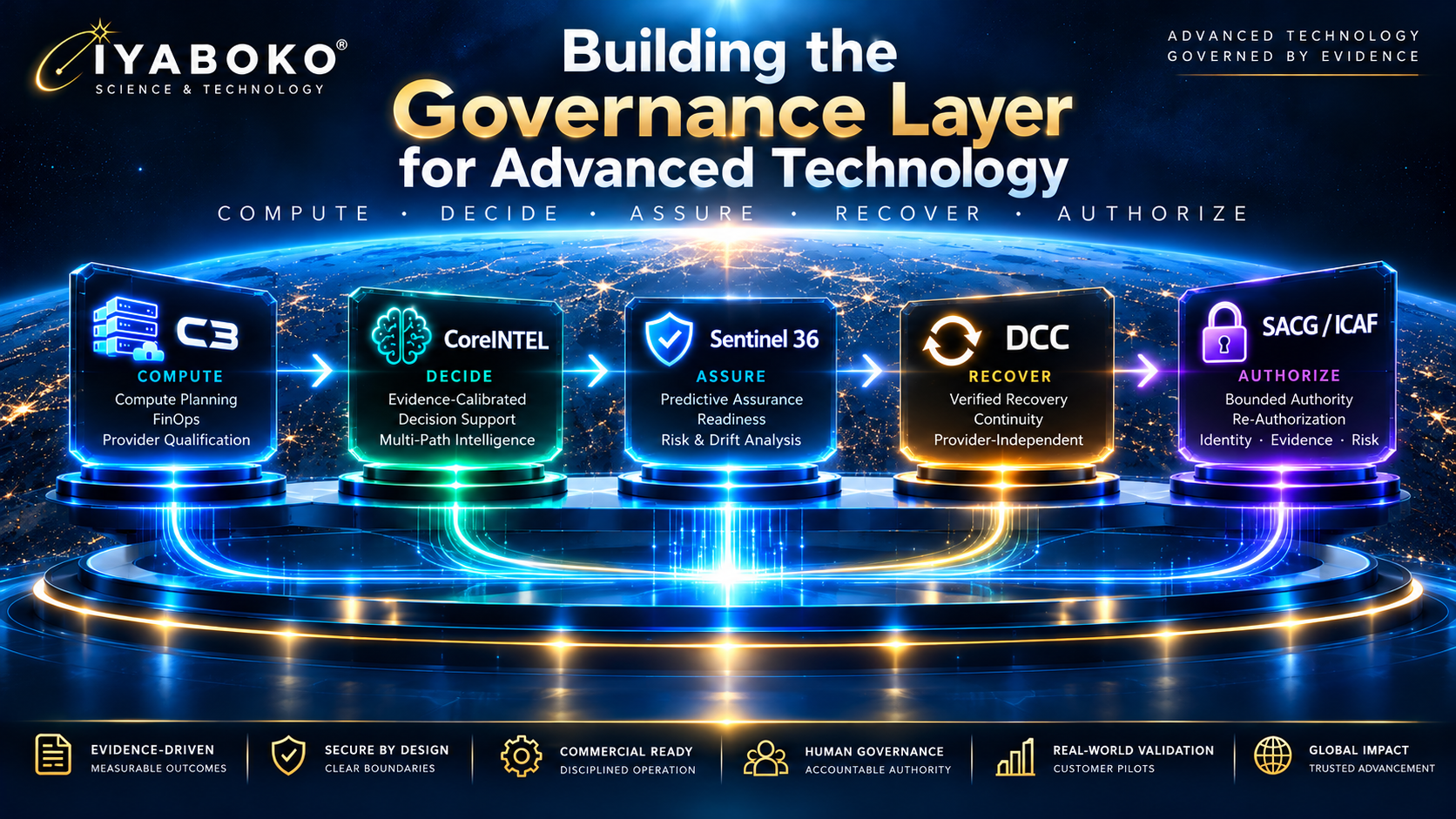
At the centre is IYABOKO C3 — the computational and decision engine that turns a real-world problem into an evidence-governed pathway from exploration to deployment.
Simple entry. Deep capability. Evidence-earned progression. Human-governed deployment.
Computational intelligence Evidence & assurance Simulation & engineering Human-governed deployment
C3 EngineProblem → evidence-governed computational pathway
7 Domain OSSpecialised science and industry environments
Software + HardwareSimulation, prototypes, HIL and physical validation pathways
Human AuthorityComputation informs authority; it does not replace it
How IYABOKO Works

One technology infrastructure. One governed development pathway.

Users begin with a real problem. IYABOKO progressively introduces the evidence, computational, engineering and assurance capabilities required as the project matures.

01

Discover

Define the problem, system context, boundaries, stakeholders and intended outcome.

02

Research & Analyse

Bring together evidence, data, assumptions, requirements and competing explanations.

03

Compute & Model

Use C3, AI and domain-specific tools to analyse, model and compare candidate pathways.

04

Build & Simulate

Progress credible concepts into software, simulations, engineering models and prototypes.

05

Assure & Validate

Challenge evidence, uncertainty, requirements and risk through Sentinel and validation pathways.

06

Pilot & Deploy

Move sufficiently supported systems toward controlled pilots, qualified review and responsible deployment.

Problem → Evidence → Intelligence → Computation → Engineering → Assurance → Pilot → Deployment → Continuity

Complexity is disclosed progressively. Early exploration remains accessible; stronger evidence and authority controls appear as responsibility increases.

Bring a Problem
Public Exploration

Start with a question, problem or early project.

Use Public AI for lightweight exploration and project preparation before moving into private workspaces, deeper computation, engineering or Sentinel assurance.

Free Public AI Problem Exploration Research & Evidence Project Preparation
IYABOKO Public AI Workspace demonstration
Public AI is temporarily unavailable. The public workspace did not initialise for this visit. You can still open the Member Portal or bring a problem to IYABOKO.
Public AI supports exploration and preparation. Verify consequential claims independently. Compare Plans
IYABOKO Technology

Five connected technology capabilities. One shared infrastructure.

Each capability has a clear role. Together they support a governed path from problem exploration and computation to evidence, assurance, learning and deployment preparation.

AI Workspace and Professional AI Workers remain distinct capabilities.

AI Workspace is the interactive human-facing environment. Specialised Professional AI Workers support defined functions within governed permissions, evidence requirements and Human Authority.

Member Portal
Engineering & Invention

Connect computational discovery with progressively deeper engineering.

The shared Engineering & Invention layer provides a common pathway for moving from computational reasoning and evidence-led discovery into simulation, digital systems, software, hardware, manufacturing and controlled physical validation. Rather than requiring every Domain OS to rebuild the same engineering infrastructure, IYABOKO provides one governed engineering foundation that can be reused across sector projects, multi-projects and megaprojects.

Computational FoundationC3Provides computational reasoning, modelling and decision preparation across the engineering pathway.
Project IntelligenceCoreINTELSupports project intelligence, evidence context and decision support across complex technical work.
Readiness & EvidenceSentinelGoverns readiness, evidence progression, findings, remediation and advancement between engineering gates.
Specialised AssuranceSACGCan provide continuity-authority and proof functions where a project requires stronger assurance.
Discover → Model → Represent → Prototype → Integrate → Manufacture → Test → Validate → Review
SIM

Simulation & Modelling

Explore system behaviour before committing resources to physical implementation.

Use simulation to investigate scenarios, operating conditions, uncertainty, failure modes, constraints, candidate architectures and design trade-offs. Projects can progress from conceptual models into higher-fidelity engineering simulations as evidence and requirements mature.

Problem → model → scenario → candidate design → comparison → evidence → next engineering gate
MD

Digital & Multidigital Systems

Build connected digital representations of systems, environments and evidence states.

IYABOKO multidigital architecture extends beyond a single isolated digital twin by allowing multiple digital representations, models, evidence streams and domain contexts to remain connected around the same project or physical system.

  • Digital twins
  • Multidigital system models
  • System-of-systems representations
  • Cross-domain relationships
  • Configuration and state history
  • Evidence provenance
  • Simulation linkage
  • Physical-system handoff

The objective is not merely to reproduce an object digitally, but to preserve the context, continuity, relationships and evidence state required to understand how that system changes over time.

SW/HW

Software & Hardware Prototyping

Progress suitable concepts from computational results into controlled executable prototypes.

  • Software prototypes
  • APIs and runtime services
  • Embedded systems
  • Sensors and instrumentation
  • Electronics
  • FPGA pathways
  • Edge computing
  • Prototype control architectures
  • Data-acquisition systems
  • Hardware interfaces

Every prototype remains linked to its requirements, assumptions, evidence and validation status. A successful software simulation does not automatically become a validated hardware claim.

RM

Robotics & Mechatronics

Develop integrated systems where software interacts with sensing, electronics, mechanics and physical behaviour.

  • Mechanical systems
  • Embedded computation
  • Sensors and actuators
  • Control logic
  • Machine perception
  • Robotics
  • Autonomous-system research
  • Human-machine interfaces
  • Safety and authority constraints

Projects can begin with simulation and digital representation before progressing into laboratory prototypes or controlled embodied systems. Human authority and project-specific safety boundaries remain explicit throughout development.

CNC

CNC & Digital Manufacturing

Move validated designs toward repeatable physical fabrication.

  • CAD preparation
  • CAM workflows
  • CNC machining
  • Additive manufacturing
  • Prototype fabrication
  • Engineering drawings
  • Manufacturing tolerances
  • Component traceability
  • Material records
  • Revision control
  • Inspection artefacts

Manufacturing outputs can remain connected to project evidence so that a physical component can be traced to its design version, assumptions, material specification and validation record.

Digital design → manufacturable artefact → inspection → evidence → approved iteration
HIL

Hardware-in-the-Loop & Physical Validation

Advance suitable systems from software-only testing toward controlled interaction with real hardware.

  • Interface validation
  • Sensor and device integration
  • Fault injection
  • Timing behaviour
  • Communications testing
  • Hardware/software interaction
  • Recovery behaviour
  • Adverse-condition testing
  • Evidence capture
  • Reproducibility testing

C3 HIL protocols can support governed computational and evidence workflows, while physical hardware validation remains a separate evidence gate requiring real hardware results. Simulation evidence and physical evidence are never treated as equivalent automatically.

TEST

Experimental Testing & Fault Campaigns

Challenge the system rather than testing only expected success conditions.

  • Boundary violations
  • Component failures
  • Sensor degradation
  • Communication loss
  • Corrupted data
  • Power interruption
  • Restart and recovery
  • Thermal stress
  • Timing faults
  • Conflicting evidence
  • Post-recovery stability

The objective is to discover where the system fails, how safely it fails, and what evidence is required before progression.

SACG

Continuity Authority & Proof

Apply specialised assurance when a project requires stronger evidence about continuity, recovery, trust or authority.

  • Evidence integrity
  • Proof-of-continuation
  • Continuation ledgers
  • Recovery and re-entry
  • Quorum evidence
  • Hardware-trust evidence
  • Authority ceilings
  • Tamper detection
  • Independent-review preparation

SACG does not replace C3 computation. It evaluates whether evidence and continuity conditions support a particular bounded authority state.

VAL

Validation & Evidence Progression

Connect every engineering stage to an explicit evidence position.

A project can progress through increasingly demanding evidence gates.

Concept → Simulation → Executable prototype → Bench testing → HIL → Physical testing → Pilot evidence → Independent review → Deployment decision

Progression is evidence-gated rather than presentation-gated. Higher engineering maturity requires stronger evidence; a polished interface, simulation result or successful internal test does not by itself establish physical, operational or independent validation.

One engineering foundation across IYABOKO.

The same Engineering & Invention infrastructure supports the seven canonical Domain OS and can also serve adjacent cross-sector projects without creating a separate engineering stack for every sector.

Space OSEnergy OSEnvironment OSHealth & Biotech OSQuantum Net OSFinancial Security OSMineral & Material OSIndustrial SystemsInfrastructureFood & Agriculture Projects
C3 DiscoveryCoreINTEL Project IntelligenceSimulation & Multidigital RepresentationSoftware / Hardware PrototypeRobotics / Mechatronics IntegrationDigital ManufacturingHIL & Experimental TestingSentinel Readiness ReviewSACG where requiredHuman-Governed Validation & Deployment Decision
Software-led · Hardware-enabled · Evidence-governed · Human-authorised
Engineering boundary.

Capability availability depends on the project, evidence maturity, facilities, qualified expertise and external safety or regulatory requirements. Physical deployment is not implied by software demonstration, and simulation evidence is not automatically equivalent to physical validation.

Evidence-Governed Progression

Innovation stays accessible. Consequential progression becomes stricter.

Early exploration should remain fast and creative. As a project moves toward prototypes, physical systems, pilots or operational use, stronger evidence, assurance and Human Authority controls become necessary.

Explore · low-friction discovery
Evidence · provenance & uncertainty
Assure · requirements & readiness
Authority · accountable progression
EX
ExploreFrame questions, investigate possibilities and develop candidate approaches without unnecessary compliance overhead.
EV
EvidenceStructure sources, data, assumptions, provenance, uncertainty and project requirements.
AS
AssuranceUse Sentinel readiness and engineering assurance to challenge whether progression is justified.
HA
Human AuthorityProfessional, statutory, contractual and operational authority remains with accountable people and institutions.
Built for Real-World Technology Development

Use IYABOKO at the level that fits your project.

From individual exploration to institutional technology programmes, the platform is designed to support progressively deeper research, computation, evidence, engineering and assurance needs.

Researchers & UniversitiesResearch development, computation, simulation and validation.
Founders & Technology CompaniesProblem definition, product research, prototypes and pilot readiness.
Engineering & Innovation TeamsModels, requirements, evidence and technical assurance.
Enterprise & IndustryTechnology assessment, evidence governance and controlled innovation.
Government & Public SectorEvidence-led evaluation, resilience and governed pilot pathways.
Evidence & Trust

Make the difference between an idea, a demonstration and validated technology visible.

IYABOKO is designed to show what has been demonstrated, what evidence supports it, what remains uncertain, what requires independent validation and who has authority to approve progression.

H/Q

Maturity & Evidence

Separate project maturity from the quality and completeness of supporting evidence.

S

Sentinel Assurance

Requirements, findings, uncertainty, remediation and reassessment create a governed progression record.

EI

Public Evidence

Selected demonstrations, validation artefacts and research outcomes can be inspected where publication is appropriate.

HR

Authority Boundary

Professional sign-off, certification, statutory approval and operational authority remain with qualified people and institutions.

Evidence supports decisions. It does not erase accountability.

IYABOKO distinguishes public simulation, prototype evidence, controlled pilots and validated deployment rather than presenting them as equivalent states.

View Public Evidence

Bring a real-world problem to IYABOKO.

Begin with the problem. IYABOKO helps determine the evidence, computational, engineering and assurance pathway required to move forward responsibly.